Why Performance Metrics Matter
Every security company wants to provide reliable service, satisfy clients, and maintain a professional workforce. Yet many organizations still evaluate guard performance based on intuition, occasional supervisor observations, or client complaints. While experience certainly has value, relying solely on subjective opinions makes it difficult to identify trends, recognize top performers, or address operational issues before they become costly.
Performance metrics provide a structured, objective way to evaluate how well guards perform their daily responsibilities. Instead of asking, "Is this guard doing a good job?" managers can answer measurable questions such as:
- Are patrols completed on time?
- How quickly are incidents reported?
- Are checkpoints being visited as scheduled?
- Is attendance improving or declining?
- Which guards consistently exceed expectations?
By measuring key performance indicators (KPIs), security companies gain valuable insights into workforce productivity, operational efficiency, and service quality. These insights support better decision-making, improve accountability, and help organizations deliver a consistently high level of service across every client site.
What Are Security Guard KPIs?
Key Performance Indicators (KPIs) are measurable values that help organizations evaluate whether employees and operations are meeting predefined goals.
For security guards, KPIs go beyond simply recording whether someone showed up for work. They provide visibility into how effectively guards perform patrols, respond to incidents, communicate with supervisors, and comply with company procedures.
The best KPIs are:
- Easy to measure
- Relevant to daily responsibilities
- Consistent across all sites
- Actionable for supervisors
- Aligned with client expectations
Rather than using KPIs to "monitor employees," successful organizations use them to identify coaching opportunities, improve operational processes, and recognize outstanding performance.
The Difference Between Activity and Performance
One common mistake is confusing activity with performance.
For example, a guard may complete ten patrols during a shift. While this shows activity, it doesn't necessarily indicate quality. Were the patrols completed on schedule? Were checkpoints verified? Were any hazards documented? Did the guard respond appropriately to incidents?
Performance combines both quantity and quality.
Instead of measuring only how much work is completed, organizations should also evaluate how well that work meets operational standards. A balanced KPI framework considers efficiency, compliance, communication, accuracy, and professionalism.
10 Essential Performance Metrics Every Security Company Should Track
1. Patrol Completion Rate
Patrol completion is one of the most fundamental indicators of guard performance.
This metric measures the percentage of scheduled patrols successfully completed during a shift.
A consistently high completion rate demonstrates reliability and operational discipline, while missed patrols may indicate staffing issues, scheduling conflicts, or inadequate supervision.
GPS tracking and QR checkpoints make patrol verification objective and transparent.
2. On-Time Shift Attendance
Reliable attendance is critical for maintaining uninterrupted security coverage.
Managers should monitor:
- Late arrivals
- Early departures
- Missed shifts
- Unscheduled absences
- Overtime frequency
Consistent attendance improves operational stability while reducing scheduling disruptions and additional labor costs.
3. Incident Reporting Quality
Incident reports are among the most important documents a security company produces.
Rather than measuring only the number of reports submitted, managers should evaluate:
- Completeness
- Accuracy
- Supporting photos
- Clear descriptions
- Timely submission
- Proper categorization
High-quality documentation protects both clients and the security company while simplifying compliance and future investigations.
4. Response Time
Response time measures how quickly guards react when an incident occurs.
Whether responding to an alarm, suspicious activity, or a client request, faster response times generally improve safety and client satisfaction.
Tracking this metric also helps identify operational bottlenecks and staffing challenges.
5. Checkpoint Compliance
Many patrol contracts require guards to visit designated checkpoints at scheduled intervals.
Checkpoint compliance measures:
- Visited checkpoints
- Missed checkpoints
- Late checkpoints
- Route completion
Digital checkpoint verification provides reliable proof that contractual obligations have been fulfilled.
6. GPS Verification
GPS verification confirms that guards were physically present at the correct location when completing patrols or submitting reports.
This metric helps prevent false reporting while increasing transparency and accountability.
GPS data also supports dispute resolution and client reporting.
7. Report Submission Time
How quickly are incidents documented after they occur?
Delays can reduce report accuracy and make investigations more difficult.
Modern mobile applications allow guards to submit reports immediately from the field, ensuring that important details are captured while events are still fresh.
8. Training Completion
Professional development should continue long after initial onboarding.
Managers should monitor:
- Required certifications
- Refresher training
- Safety courses
- Compliance training
- Technology training
Well-trained guards are generally more confident, make better decisions, and provide higher-quality service.
9. Client Satisfaction
Operational performance ultimately affects the client experience.
Useful client-focused KPIs include:
- Service ratings
- Contract renewals
- Complaint frequency
- Positive feedback
- Response quality
Combining operational data with client feedback provides a more complete view of overall performance.
10. Compliance Score
Compliance metrics help ensure that guards consistently follow company policies and regulatory requirements.
This may include:
- Uniform compliance
- Patrol completion
- Required documentation
- Incident reporting standards
- SOP adherence
- Training completion
Maintaining strong compliance reduces operational risk and improves audit readiness.
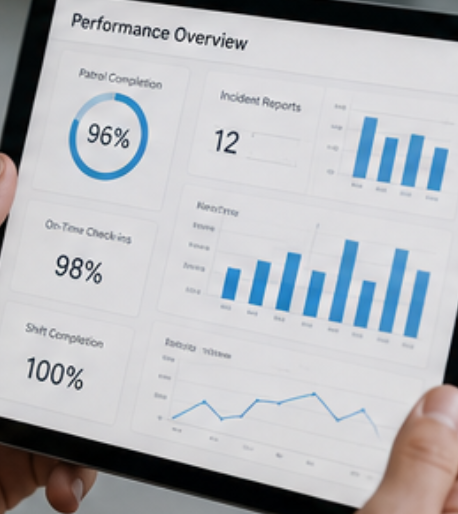
Building a KPI Dashboard
Collecting performance data is valuable, but presenting it in a clear and actionable format is equally important.
A well-designed KPI dashboard allows managers to identify trends at a glance.
Typical dashboard widgets include:
- Active guards
- Patrol completion percentage
- Missed checkpoints
- Incident volume
- Attendance statistics
- Average response time
- Training status
- Compliance scores
- Client satisfaction metrics
Real-time dashboards eliminate the need to compile manual reports and support faster operational decisions.
Using Performance Reviews Effectively
Performance reviews should be based on objective data rather than personal opinions.
Regular one-on-one meetings give supervisors the opportunity to:
- Recognize strong performance
- Discuss challenges
- Set measurable goals
- Identify training needs
- Encourage professional growth
When supported by accurate KPI data, performance reviews become constructive coaching sessions instead of disciplinary conversations.
Common Mistakes When Measuring Performance
Even organizations that track KPIs can make mistakes if the wrong metrics are used or data is interpreted incorrectly.
Some common issues include:
- Measuring quantity instead of quality
- Focusing only on negative outcomes
- Ignoring client feedback
- Tracking too many KPIs at once
- Using inconsistent evaluation criteria
- Relying on manual spreadsheets
- Failing to share performance expectations with guards
A successful KPI program should be transparent, consistent, and designed to support continuous improvement.
How Technology Improves KPI Tracking
Manual data collection is time-consuming and often inaccurate.
Cloud-based security management platforms automatically capture operational data throughout the workday.
Instead of manually updating spreadsheets, organizations can automatically measure:
- Shift attendance
- Patrol completion
- GPS verification
- Checkpoint scans
- Incident reports
- Response times
- Workforce activity
- Operational trends
Automation reduces administrative work while providing managers with reliable, real-time insights.
How OPSY Helps Measure Guard Performance
OPSY provides security companies with a centralized platform for monitoring workforce performance through real-time operational dashboards and automated analytics.
With OPSY, managers can:
- Track patrol completion rates
- Verify guard activity using GPS and QR checkpoints
- Monitor attendance and shift status
- Review incident reporting quality
- Measure operational KPIs across multiple locations
- Generate automated PDF and Excel reports
- Maintain complete audit logs
- Identify performance trends using interactive dashboards
By transforming operational data into actionable insights, OPSY helps organizations improve accountability, optimize workforce performance, and deliver higher-quality security services.
Conclusion
Performance metrics are essential for building professional, accountable, and high-performing security teams. Rather than relying on assumptions or occasional observations, organizations should use measurable KPIs to evaluate patrol completion, attendance, incident reporting, response times, compliance, and client satisfaction.
When combined with modern security management software, these metrics provide real-time visibility into daily operations while supporting better decision-making and continuous improvement.
For security companies looking to scale, improve service quality, and strengthen client relationships, performance measurement is no longer optional—it is a fundamental component of operational excellence.
Frequently Asked Questions
What are KPIs for security guards?
KPIs are measurable indicators used to evaluate guard performance, including patrol completion, attendance, incident reporting, response times, and compliance with company procedures.
Why should security companies track guard performance?
Tracking performance helps improve accountability, identify operational issues, support employee development, and ensure consistent service quality across all client locations.
How often should guard performance be reviewed?
Most organizations benefit from monthly KPI reviews, quarterly performance evaluations, and ongoing monitoring through real-time dashboards.
What tools can automate KPI tracking?
Modern cloud-based security management platforms, such as OPSY, automatically track patrols, GPS activity, attendance, incident reports, and other operational metrics without relying on manual spreadsheets.
Which KPI is the most important?
There is no single most important KPI. The most effective security companies monitor a balanced set of metrics that includes operational efficiency, compliance, client satisfaction, and workforce performance.