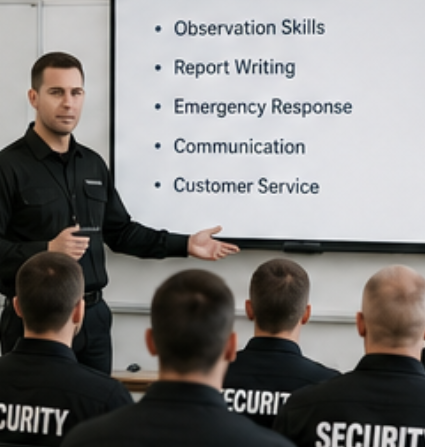
Why Security Guard Training Matters More Than Ever
The security industry has changed dramatically over the past decade. Security guards are no longer expected to simply observe and report suspicious activity. Today's professionals are responsible for protecting people, managing emergencies, documenting incidents, communicating with clients, operating digital tools, and representing the companies they serve.
As client expectations continue to rise, security companies face increasing pressure to deliver highly trained, reliable, and professional personnel. Organizations that invest in comprehensive training programs consistently outperform those that rely solely on basic licensing requirements or on-the-job experience.
Training directly affects nearly every aspect of security operations. Well-trained guards respond more confidently during emergencies, complete patrols more consistently, produce higher-quality incident reports, and provide a better experience for clients and visitors. At the same time, continuous education helps reduce operational mistakes, improve compliance, and increase employee confidence.
Modern security companies should view training not as a one-time event during onboarding, but as an ongoing investment that supports long-term operational excellence.
The Changing Role of Modern Security Guards
The responsibilities of security guards continue to expand alongside advances in technology and changing client needs.
Today's guards may be expected to:
- Conduct scheduled patrols across multiple sites
- Monitor surveillance systems
- Verify visitor access
- Respond to alarms
- Report incidents using mobile applications
- Coordinate with emergency responders
- Document safety hazards
- Provide customer service
- Support workplace safety initiatives
- Follow regulatory and compliance requirements
Because of these evolving responsibilities, training programs must cover far more than basic security procedures. Guards need technical skills, communication abilities, problem-solving techniques, and confidence in using digital tools that support daily operations.
Organizations that embrace continuous learning are better prepared to adapt to new technologies and changing operational requirements.
Core Skills Every Security Guard Should Master
An effective training program should build both technical knowledge and practical workplace skills.
Communication Skills
Clear communication is essential for documenting incidents, interacting with clients, coordinating with supervisors, and managing difficult situations. Guards should learn how to write professional reports, communicate calmly during emergencies, and provide excellent customer service.
Situational Awareness
One of the most valuable abilities a guard can develop is recognizing unusual behavior before it becomes a serious incident. Training should focus on observation techniques, identifying potential risks, and making informed decisions under pressure.
Emergency Response
Every security professional should understand how to respond to medical emergencies, fires, unauthorized access, evacuations, workplace violence, and other critical incidents. Regular drills help reinforce these procedures and improve confidence during real-world situations.
Patrol Procedures
Patrol training should include route planning, checkpoint verification, hazard identification, and documenting observations accurately. Guards should understand not only where to patrol but also why specific areas require additional attention.
Customer Service
Security guards often serve as the first point of contact for employees, visitors, and contractors. Professional behavior, empathy, and effective conflict resolution contribute to a positive client experience and strengthen the company's reputation.
Building an Effective Training Program
Successful training begins with a structured plan rather than informal shadowing or inconsistent instructions.
A comprehensive program typically includes:
- Company orientation
- Client-specific post orders
- Standard operating procedures (SOPs)
- Patrol techniques
- Incident reporting
- Emergency response
- Workplace safety
- Technology training
- Compliance requirements
- Customer service
Training should combine classroom instruction, practical exercises, and supervised field experience.
Organizations that standardize onboarding reduce confusion, improve consistency across locations, and accelerate employee readiness.
Using Technology in Guard Training
Technology has become an essential component of modern security operations, making digital literacy a critical skill for every security guard.
Today's guards frequently rely on mobile applications to:
- View assigned shifts
- Access patrol routes
- Scan QR checkpoints
- Submit incident reports
- Capture photos
- Receive operational updates
- Request assistance
- Communicate with supervisors
Training should ensure that every employee is comfortable using these tools before working independently.
Providing hands-on practice with mobile devices significantly reduces operational errors and increases productivity from the first day on the job.
Scenario-Based Learning
Traditional lectures alone are rarely enough to prepare guards for the unpredictable situations they encounter in the field.
Scenario-based training allows employees to apply knowledge in realistic situations while building confidence and decision-making skills.
Examples include:
- Unauthorized access attempts
- Suspicious packages
- Medical emergencies
- Fire alarms
- Aggressive individuals
- Equipment failures
- Workplace accidents
- Lost visitors
- Severe weather events
These exercises encourage critical thinking while helping guards understand company procedures in real-world contexts.
Continuous Learning and Professional Development
Training should not end after onboarding.
Security companies that invest in ongoing education typically experience higher employee engagement, lower turnover, and improved operational performance.
Continuous learning may include:
- Monthly refresher sessions
- Annual compliance training
- Emergency response drills
- Leadership development
- Customer service workshops
- Technology updates
- New client procedures
- Regulatory changes
Providing opportunities for career growth also demonstrates that the organization values its employees, making it easier to retain experienced personnel.
Measuring Training Success
An effective training program should be evaluated using measurable performance indicators rather than assumptions.
Organizations can assess training effectiveness by monitoring:
- Patrol completion rates
- Incident reporting quality
- Attendance and punctuality
- Response times
- Compliance scores
- Client satisfaction
- Employee confidence
- Supervisor evaluations
- Training completion rates
- Operational errors
Reviewing these metrics regularly helps managers identify areas where additional coaching or updated training materials may be needed.
Common Training Mistakes
Even experienced security companies can undermine training effectiveness by relying on outdated methods or inconsistent processes.
Some of the most common mistakes include:
- Treating training as a one-time event
- Providing inconsistent onboarding across different sites
- Focusing only on regulations while ignoring practical skills
- Neglecting communication and customer service training
- Failing to introduce guards to digital tools
- Not updating procedures as regulations or client requirements change
- Measuring attendance instead of learning outcomes
- Providing little feedback after training is completed
Avoiding these pitfalls helps organizations build more confident, capable, and engaged security professionals.
How OPSY Supports Security Guard Training
OPSY helps security companies standardize operations and reinforce training by providing guards and supervisors with a centralized digital platform for daily activities.
With OPSY, organizations can:
- Give guards instant access to post orders and operational instructions
- Deliver consistent procedures across multiple locations
- Provide digital patrol routes and checkpoint verification
- Simplify incident reporting with photos, timestamps, and GPS data
- Monitor training completion alongside operational performance
- Measure guard KPIs through real-time dashboards
- Generate reports that support coaching and performance reviews
- Maintain complete audit logs for compliance and accountability
By combining workforce management, patrol tracking, reporting, and analytics, OPSY helps organizations reinforce best practices every day—not just during onboarding.
Conclusion
Modern security guard training extends far beyond meeting licensing requirements. As security operations become more complex, organizations must prepare guards to handle technology, communicate effectively, respond confidently to emergencies, and consistently deliver high-quality service.
Companies that invest in structured onboarding, continuous learning, scenario-based training, and measurable performance improvement build stronger teams and earn greater trust from clients.
Training is no longer simply a compliance requirement—it is a strategic investment that improves operational efficiency, strengthens employee engagement, reduces risk, and supports long-term business growth.
Frequently Asked Questions
Why is continuous training important for security guards?
Continuous training ensures guards remain up to date with new technologies, changing regulations, client expectations, and emergency response procedures while improving confidence and operational performance.
What should every security guard training program include?
A comprehensive program should cover patrol procedures, incident reporting, emergency response, communication skills, customer service, compliance requirements, workplace safety, and technology training.
How can technology improve security guard training?
Mobile applications, digital patrol systems, GPS verification, and online learning platforms help standardize training, reduce administrative work, and reinforce operational procedures in the field.
How often should security guards receive additional training?
Most organizations benefit from monthly refresher sessions, annual compliance training, scenario-based exercises, and ongoing coaching supported by performance data.
How does OPSY help train security guards?
OPSY supports standardized operations by providing digital post orders, patrol guidance, incident reporting, operational dashboards, and performance analytics that reinforce training every day.